|
Gibson Shield of Scotland More common shields associated with the Gibson name are shown below.
|
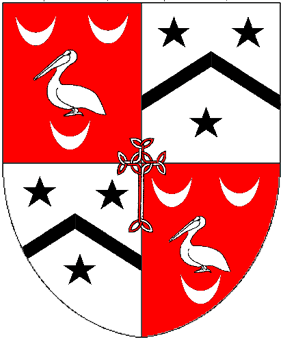
The Escutcheon of the Gibson Family This family escutcheon (shield) from the family coat of arms was presented to me by my father. He spent many years researching our heritage before discovering it. Despite a fruitless search of the internet, I have never found a similar coat of arms for the Gibson surname. My father traced our family back to a Gibson family living in or around the Orkney's. The surname Gibson is a baptismal name which means one who was the son of Gibs, which means "pledge, bright". Other more common shields are easily found on the Internet. Significance of the escutcheon:
(The celtic cross was recently added and not part of the shield.)
|
Origins of TobyI know already. Just about everyone I meet has an aunt who has a dog named TobySo where did I get that name and why are so many dogs also named Toby. And what about those mugs? The Book of Tobit or TobiasThe name 'Toby', comes from the Book of Tobit (also Tobe). Tobe was an Israelite who spends his whole life doing acts of charity and goodness and is rewarded by winding up a blind beggar living in exile in the land of Nineveh. Wanting to die, he prays to God for death but is refused. Recalling that he is owed money in the distant land of Media, he sends his son, Tobias (Tobiah), to collect the debt from a friend. Tobias is guided by the angel Raphael. With the help of Raphy, Tobias catches a fish with curative properties. While on the way to collect the debt, Tobias also manages to save King Raguel's daughter from a demon. Tobias collects the debt, marries the daughter,and restores his father's eyesight with the fish! not bad for a the son of a blind beggar..The Book of Tobit is not found in every version of the Bible. For some reason some people doubt its validity. Oh well. Here is the story from the New American Bible. The Book of Tobit But this does little to explain why so many dogs are named Toby. Punch & JudyPunch & Judy is that ever popular puppet show, which I believe, started in Italy, but made its way north to England where it is still considered a major art form. What is not widely known (in the U.S. of A., that is) is Punch had a bull terrier that was named Toby. Sometimes Toby was a puppet but more often than not it was an actual living, breathing, dog. Toby would often be painted up with make up similar to the Our Gang known as Pete. He would also wear a costume that almost always included a frilly collar. Some Punch & Judy performers trained Toby to pass the hat after the show! At one time Toby became so important and so recognizable that the shows were often referred to as Punch & Toby shows. The dog is not used as often anymore, and when he is, he is typically a puppet. However this does answer the question of why Toby is such a popular name for a dog!
Punch or more correctly, Punchinello or in Italian Pulcinella, was hook nosed, humpbacked character (hey, wait a minute, let's not get personal here!), the most popular of marionettes and glove puppets and the chief figure in the Punch-and-Judy puppet show. Brutal, vindictive, and deceitful, he is usually at odds with authority. His character had roots in the Roman clown and the comic country bumpkin. More modern origins can be traced to Pulcinella, a character who appeared in the Italian Commedia Dell'Arte in the 17th century. It is not certain who was the first Pulcinella, although claims have been made on behalf of Silvio Fiorillo, a professional comedian who was performing at the beginning of the 17th century. In early pictorial representations, he is depicted as large, shambling, and stupid-looking, dressed in a loose white shirt and very full trousers. The Italian actors soon began to travel throughout Europe, bringing with them the puppet showmen. Polichinelle, the French adaptation of the character Pulcinella, became firmly established in France by the middle of the 17th century. The origin of the grotesque, humpbacked, and hook nosed marionette Polichinelle may have resulted from a fusion of the Italian character Pulcinella with an earlier French tradition of humpbacked fools. A similar tradition of the humpbacked fool existed in England when the first Italian puppeteers arrived after the restoration of Charles II in 1660. Two years later, the first references to Punchinello, soon shortened to Punch, appeared in the writings of the English diarist Samuel Pepys. By 1700 practically every puppet show in England featured Punch, and his wife, Judy, originally called Joan, was also a well-known figure. Traveling showmen carried these plays to country wakes (festivals) in the summer and visited London for the fairs in August and September. Early in the 18th century Punch became famous in political circles through the use of the name by Martin Powell, a marionette showman, in a scurrilous attack on Robert Harley entitled A Second Tale of a Tub (1715). In the 1790s the marionettes lost their popularity at the fairs. There was, however, a new interest in the humbler glove puppets, and in this form the Punch-and-Judy play became a success. Plots varied, but the principal players were Toby the Dog, the Baby, the Doctor, the Negro Servant, the Beadle, the Clown, the Hangman, the Ghost of Judy, Mr. Jones, Hector the Horse, the Crocodile, and the Devil. The hooked nose, the humped back, the tendency to wife beating and outrageous lawlessness typical of the English Punch were established characteristics by the 19th century. In England in the second half of the 20th century, more than 50 professional puppeteers carried on the vigorous tradition of Punch's humor. His influence survives in such common phrases as "pleased as Punch." In France the puppet Polichinelle had a similar history. His popularity, however, declined during the 19th and 20th centuries, and he has disappeared as a comic figure, being replaced by Guignol. Other puppets have developed from the same origins as Punch, such as Petrushka (Petrouchka) in Russia. Lastly a magazine devoted to political satire and humor was started in the late 1900s and was titled Punch in an attempt to capitalize on the famous puppet. The magazine remained in print for over one hundred years So how did the show go? See an edited script based on the original that first appeared in Henry Mayhew's London Labour and the London Poor Toby in Merry Ol' England Barry Delaney in "The Subject of Jugs" explains that in 18th- century England, a common street mugger was known as a Low Toby, and a mounted highwayman was called a High Toby. 
Toby Mugs. Toby mugs are ceramic mugs sold in Britain. The mugs have caricatures of old salts wearing tri-corn hats. They are quite popular in the collecting trade.There are several different- opinions as to the origin of the toby mug got it's name. Some people say it was named for Sir Toby Belch, a boisterous and comic knight in Shakespeare's comedy, Twelfth Night. Others cite Uncle Toby from Laurence Stern's novel Tristram Shandy, published in 1759. The general consensus, however, is that the toby mug was named for Toby Fillpot, a character in the song "Toby Filpot" or "The Brown Jug" composed in 1761 by the Rev. Francis Fawkes and adapted from an old Italian poem by Geranimo Amelto. Toby Filpot or The Brown Jug Dear Tom, this brown jug that now foams with mild ale 
|
|